


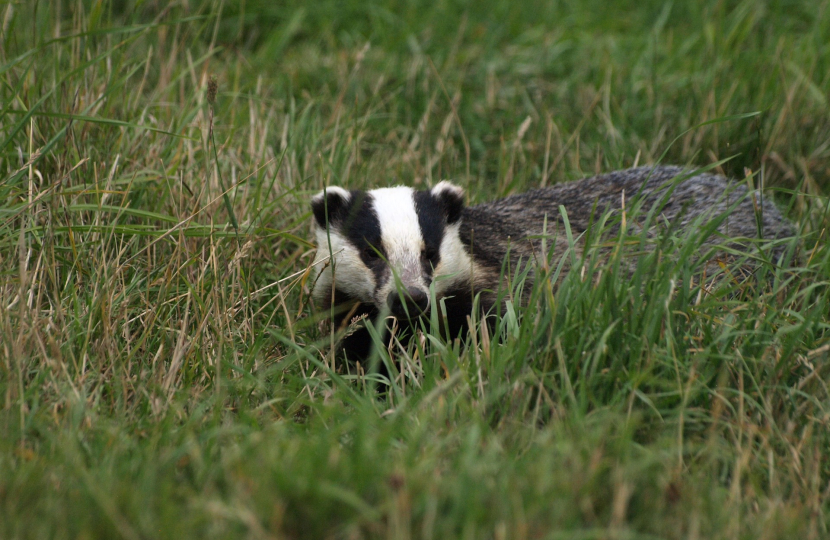
Badgers and Bovine TB
Bovine TB (bTB) is a serious disease and its incidence has been increasing steadily since the 1980s. It increased nine-fold between 1997 and 2010 and caused 26,602 cattle to be slaughtered in 2013 alone. The disease has cost the taxpayer around £100 million per year. and over 38,000 cattle are slaughtered in 2021 due to infection. Our cattle breeders suffer the loss of prize-winning animals and valued herds and this loss creates considerable trauma in the farming industry. It is important to bear in mind that, if left unchecked, bTB could pose an increased risk to other animal and human health. The last Conservative government was committed to using all available means to address it and pursued a comprehensive Strategy for England to become TB free by 2038. I am pleased to see that the current government is also committed to this.
The strategy involves a wide range of tools. Cattle movement controls and the testing regime will be strengthened to stop infection from spreading between herds. Biosecurity will be improved by helping farmers understand the disease risk of cattle they buy. There will be continued investment in developing a new vaccine for cattle and an oral badger vaccine. There will also be match-funding for badger vaccination projects in the 'edge areas' at the frontier of the disease, with the aim of increasing TB immunity in uninfected badgers - a development greatly welcome.
Doing nothing is not an option. Bovine TB is a terrible disease which is devastating our cattle and dairy industries and causing misery in rural communities. We need to do everything we can to make England TB free. We want to make England TB free in order to stop future badger generations from suffering the slow painful death that TB results in.
Badger Culls
As lessons from other countries have shown, such as in Australia, New Zealand, Ireland and the USA, where there is a reservoir of disease in wildlife, combating TB requires long-term solutions that couple these measures with tackling the reservoir through culling. Since the initial badger culls in 2013, a policy of badger control has been rolled out to other parts of the High-Risk Area (HRA) in the south-west and west of England. The latest evidence has shown that the incidence of the disease in the first cull areas of Somerset and Gloucester fell substantially, by 37% and 66% respectively relative to comparison areas.
However, the badger is an iconic, protected species. No one wants to cull them forever, and widespread badger culling was only ever envisaged as a phase of the strategy, not a perpetual state of affairs. Ministers only ever envisaged that the badger cull would be a phase in the strategy to reduce the weight of the disease in the wildlife population. I am pleased that the ongoing consultation sets out how they intend to phase out culling and accelerate the next phases of the strategy, especially improved diagnostic testing.
While the majority of our disease control measures focus on cattle, these proposals will retain badger culling as an option in targeted parts only of the High-Risk Area and Edge Areas, where there are high levels of infection in cattle and where evidence suggests badgers are part of the problem in the spread of disease to these herds. Culling would then only continue in these targeted areas until the disease situation has been deemed to have improved, following an annual review by the UK’s Chief Veterinary Officer. At this point, badger vaccination would be used to ensure the results achieved through culling are maintained. This sets out a clear exit strategy to non-lethal control preventing the return of disease in these areas.
The strategy builds on our investment in wider scale badger vaccination, which is now much more of a reality, with more farms involved in vaccination programmes than ever before, including in areas where badger culling has ended.
Cattle/Bovine TB Vaccine
In July 2020, the Government announced that world-leading cattle bTB vaccination trials were set to get underway in England and Wales as a result of a major breakthrough by Government scientists. These trials enable work to accelerate towards planned deployment of a cattle vaccine. While the candidate BCG vaccine will never provide full protection, it promises to be a valuable additional tool if deployed with a test to detect infected cattle among vaccinated cattle (DIVA test). Government scientists have now developed a candidate DIVA test. Like other veterinary medicines, both the Cattle BCG vaccine and the DIVA skin test will need Veterinary Medicines Directorate marketing authorisations before they can be deployed.
In July 2021, Phase 1 trials began in England, which focused on the safety and performance of the DIVA skin test in unvaccinated animals. Performed on ten farms with 524 participating animals, Phase 1 was completed in May 2022. The second phase of the field trials assessed the safety of the CattleBCG vaccine and the safety and performance of the DIVA skin test in vaccinated cattle. The results, completed in November 2023, were successful. As of March 2026, work on Phase 3 is officially underway and six of the eleven participating farms have completed all on-farm activities to gather additional data on the performance of the companion DIVA skin test in a larger number of BCG vaccinated animals, and to explore options to optimise its use. On-farm activity across the remaining farms is expected to be completed by summer 2026.
It is encouraging that work on developing a deployable TB vaccine for cattle continues at pace and is on track to be completed soon. Should Phase 3 trials return positive results, this vaccine can be rolled out across England and Wales in the coming years. There is no single answer to tackling bovine TB, but by deploying a range of policy interventions, we can turn the tide on this terrible disease and achieve the long-term objective of eradicating it by 2038.