


Dementia is the leading cause of death in England and one in two people will be directly affected by it - either they will care for someone with the condition, develop it themselves, or both. It also has a high social cost, with around £34.7 billion a year currently spent on healthcare, social care and informal care. Annual costs are predicted to rise to over £94 billion by 2040.
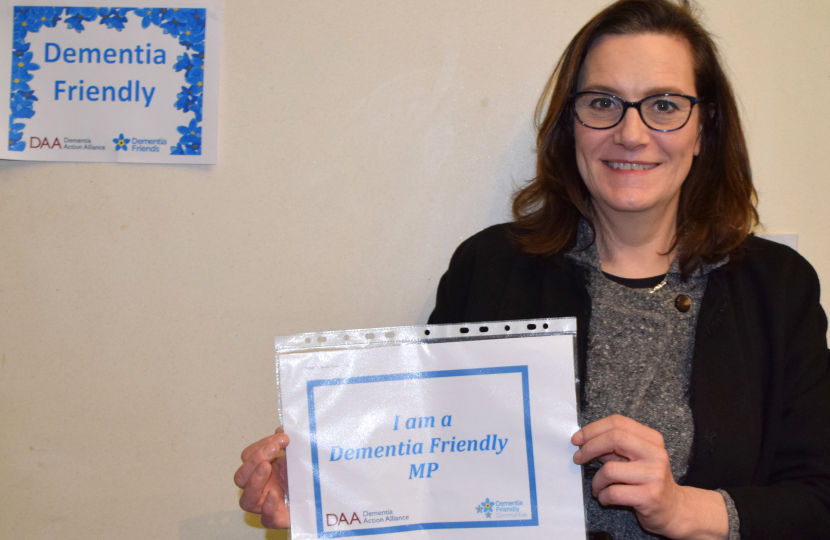
Rebecca has long supported Dementia charities and is a Dementia Friend. At Conservative Party Conference 2026, Rebecca Harris MP visited the Dementia UK stand to hear more about their mission. The charity took the opportunity to spread their vital message: families affected by dementia have waited too long for better care and support. They also promoted their #PromiseToCare campaign, calling on the Government and MPs to deliver the change families have been promised.
“As a long-standing Dementia Friend, I know how important charities like Dementia UK are to secure better support for patients. I greatly appreciate the extensive efforts of Dementia UK, and support their mission to improve the lives of those affected by this terrible condition.” - Dame Rebecca Harris MP, October 2026
UPDATE – MARCH 2024
In the Autumn Statement in November 2023, the Government announced up to £20 million of additional funding for the launch of a Clinical Trials Delivery Accelerator focused on Dementia. This will be delivered by the Dame Barbara Windsor Dementia Mission and the Medical Research Council. The Dementia Trials Accelerator aims to embed more innovation in how clinical trials are designed and delivered to increase the speed and quality, while driving down the cost of large-scale trials.
The Government also hosted a roundtable and reception at No.10 Downing Street to further accelerate efforts to tackle this devastating illness. At this event Scott Mitchell was announced as the People’s Champion for the Dementia Mission, the appointment of the Medicines Discovery Catapult as the delivery partner for the establishment of the Neurodegeneration Initiative and the award of a share of £6 million funding to ten projects through Innovate UK’s Small Business Research Initiative dementia biomarker tools competition.
UPDATE - AUGUST 2022
I am pleased that the Prime Minister has launched a national mission to tackle dementia in honour of Dame Barbara Windsor, doubling research funding by 2024 to beat this awful disease.
Up to 40% of dementia cases are potentially preventable, but clinical trials remain under-resourced and causes are still poorly understood. That is why the Prime Minister launched the ‘Dame Barbara Windsor Dementia Mission’ on 14 August, ringfencing £95 million to speed up research with a new Covid vaccine-style Taskforce, boosting the number of clinical trials and delivering on our manifesto commitment to double dementia research by 2024/25, reaching a total of £160 million a year.
More clinical trials are needed but these are often overly time consuming, with resources wasted on trying to find volunteers. The Prime Minister has issued a call for volunteers with or without a family history of dementia to come forward and sign up for clinical trials for preventative therapies, nicknamed “Babs’ Army.’ Volunteers can register their interest through the Join Dementia Research website. The new taskforce, combined with the extra funding, will work to reduce the cost of trials while speeding up delivery. Existing National Institute for Health and Care Research infrastructure will be used, building on new ways of working pioneered during covid vaccination clinical trials.
Together, we can beat this awful disease and honour an exceptional woman who campaigned tirelessly for change. For more information on the 'Dame Barbara Windsor Dementia Mission', click here.
THE 10-YEAR PLAN FOR DEMENTIA:
The Government is making good progress in creating the 10 Year Plan and it will be published later on this year. It has three main focuses on ensuring the newest medicines are readily available, emerging science and technology is applied quickly and efficiently and outcomes for patients continue to improve. It will also cover those with dementia and their carers and will include diagnosis, risk reduction and prevention and research. The Government is consulting the Dementia Programme Board alongside Alzheimer’s Research UK and Alzheimer’s Society in formulating this strategy.
NHS England currently have the Well Pathway for Dementia and this 10 Year Plan will build on this further. The Well Plan designed for health and social care staff sets out five main areas – Preventing Well, Diagnosing Well, Supporting Well, Living Well and Dying Well. It ensures that patients and families will always receive the best support and advice at every stage.
Another key element that the plan will focus on is the 40% of cases of dementia that are preventable and will provide the actions we can all take to limit our chances of contracting the disease. The establishment of the Office of Health Disparities last year aims to focus the Government on breaking the link between your background and how this informs your prospects in life and reducing inequalities in health outcomes around the country.
Dementia is not a given part of the aging process and there can be interventions and advice given to improve brain health. Health and care professionals can access the ‘All Our Health’ Dementia information which sets out guidance in detail in how best dementia can be prevented. This includes maintaining a good blood pressure, regular exercise, a healthy weight, limited alcohol intake and stopping smoking. 15 million people aged 40-74 are eligible for an NHS Health Check and an awareness of how to maintain a healthy brain is included as part of this.
Dementia Care
I believe increasing public awareness and understanding of dementia among the wider public is vital to ensure that people are supported to live well with the condition. There are over 3 million Dementia Friends in the UK and my whole office has taken Dementia Friends training.
Research is crucial to understanding and tackling dementia. In 2017, the Government launched the UK Dementia Research Institute, in partnership with the Alzheimer's Society and Alzheimer's Research UK, with £290m funding, the single biggest investment ever made in the UK in this field. Under the Challenge on Dementia 2020 strategy, the Government's commitment to spend over £300m on dementia research between 2015 and 2020 was met a year early, with £341m being spent by March 2019 through the Department of Business, Energy and Industrial Strategy, and the Department of Health and Social Care. The Government is also supporting the £79 million Accelerating Detection of Disease challenge, a project bringing together the NHS, industry and leading charities to support research into the early diagnosis of disease, including dementia.
By the end of 2020, all relevant staff were scheduled to have received appropriate dementia training, including training relevant staff to be able to signpost interested individuals towards research via the Join Dementia Research Service. I understand that good progress has been made against this goal, and more options are currently being explored to increase take-up of more advanced training among those who need it.
There is a commitment to improving detection, with more targeted screening and Rapid Access Diagnostic Centres, so that in 10 years’ time these measures will help achieve 55,000 more people surviving cancer each year, and 100,000 heart attacks, strokes and dementia cases being prevented.